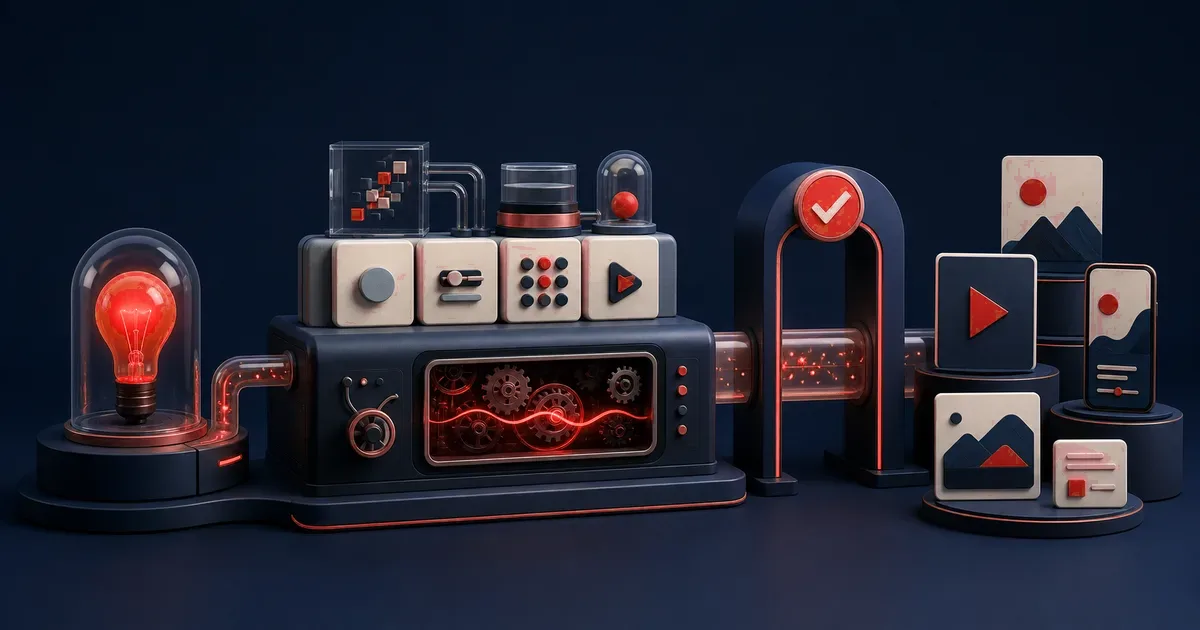
In social advertising, budget optimisation eventually hits its ceiling. Once targeting settings and bidding strategies converge, the difference is made by the creative: what you say, to whom, and in which sentence.
Before producing creative, know the boundaries. Meta's advertising standards define what content is permitted in ads, and ads are reviewed against those policies; when you build variants, those rules are part of the design. A rejected variant is not just lost time — it also unbalances the test.Meta Transparency Center — Advertising Standards (opens in a new tab)
1. Creative Testing Is Idea Testing
Most teams treat creative testing as visual testing: trying different colours and layouts for the same message. That is the method that looks for the smallest difference and teaches the least.
What you should really test is the message itself: which problem you lead with, which objection you answer, which gain you promise. The visual carries that idea.
The distinction matters financially too. Producing ten visual variants is expensive and usually yields small differences; producing three different ideas is cheaper and reveals larger ones.
When writing ideas, use customer language as your source. Objections repeated in sales calls, questions in support tickets and sentences in comments are the raw material of the best ad copy.
Creative fatigue is therefore not solved by swapping visuals alone. Presenting the same idea in a new wrapper brings a short lift followed by the same decline.
2. Break Down What You Are Testing
Rather than treating creative as one block, split it into layers: idea, format, opening three seconds, copy and call to action. Each layer answers a different question.
The table below maps those layers to the question being tested and the indicator to measure. Changing several layers at once makes the result impossible to interpret.
Write down where each layer sits in the funnel too. Judging the opening seconds by watch rate and the offer by cost per conversion produces sounder conclusions.
Splitting layers also shortens internal debate. When a visual is disliked, the discussion runs on taste; when it is written down which layer answers which question, the discussion returns to criteria.
| Layer | Question tested | Primary indicator | Caution |
|---|---|---|---|
| Idea | Which problem should lead? | Cost per conversion | Needs sufficient budget |
| Format | Video or single image? | Engagement and cost | Production costs differ |
| First three seconds | Is attention held? | Watch rate | Not a sales signal on its own |
| Copy | Is the objection answered? | Click-through rate | Avoid misleading promises |
| Call to action | Is the next step clear? | Landing continuation rate | Must match the page promise |
3. Produce Variants Against a Rule
Do not leave variant production to inspiration. Hold three to five distinct ideas, one main format per idea, and a limited number of variations.
Build ideas from different angles: showing the problem, showing the outcome, answering an objection, making a comparison, and showing the moment of use. Those five angles are a sufficient starting map for most categories.
Name every variant. A naming convention containing idea, format and date lets you remember three months later what a given asset actually was.
Include production cost in the test. An expensive video is not better than a simple image that produces the same result; compare outcomes alongside cost.
AI tools speed up variant production but do not produce ideas. Generating ten versions of the same idea only means testing the wrong idea faster.
- Start with three to five distinct ideas.
- Produce each idea in one format.
- Fix the naming convention.
- Record production cost.
- Change one layer at a time.
4. Hypothetical Scenario: High Views, Low Sales
A hypothetical furniture brand advertises with aesthetic videos showing its products. The videos earn high watch rates and the team calls the creative a success.
Yet nothing moves in add-to-cart or purchase. The review shows the audience consuming the videos as inspiration content while their questions about price, delivery time and assembly go unanswered.
The team builds a new set of ideas: the first shows delivery and assembly, the second solves the small-space problem, the third states the price range plainly. Each idea is produced in one format and compared on cost per conversion. This is a hypothetical example, not a client result or a guaranteed gain.
5. Separate Measurement From Interpretation
The most common error in creative testing is treating every number the platform reports as equally important. Engagement and watch rate tell you about attention; cost per conversion and revenue tell you about the business result.
Compare under equal conditions. Two variants running on different budgets, audiences or periods are not alternatives to each other.
Platforms provide tools for that comparison. Google Ads documentation explains that you can prepare a draft and then run the change as an experiment against the existing campaign to compare performance. Manual comparisons without such a tool are easily distorted by seasonality and budget shifts.Google Ads Help — About Campaign Drafts for Search and Display (opens in a new tab)
When interpreting a result, write down which layer of the creative worked. Filing the winning variant is not enough; the winning idea is the starting point of the next cycle.
Keep the losing variants too. Only teams that keep records know whether the same idea works six months later with a different audience.
Note the audience when reading the report. The same creative can work on a cold audience while falling flat with existing customers; that gap is not a fault of the creative but of who the message was aimed at.
Attach learning to the archive, not a person
In most teams creative knowledge lives in one person's memory. When they leave, the brand repeats the same experiments from scratch.
Store each test's result together with the idea, audience, period, budget, outcome and conclusion in one place. That archive becomes the most valuable marketing asset over time.
Read the comments as data
Comments under an ad show for free which objection is still unanswered. A recurring question is the idea for the next creative.
Reply to negative comments rather than deleting them. A reply reaches not only the commenter but the silent viewer with the same hesitation.
6. A Monthly Creative Testing Cycle
In week one, produce ideas: draw three to five from customer language, comments and sales objections, and write each in one sentence.
Week two is production: build each idea in one format, follow the naming convention and check against advertising policies.
Week three is delivery: run the variants under equal conditions, resist early intervention and split the budget evenly.
Week four is evaluation: identify the winning idea, write the learning into the archive and derive the next cycle's ideas from that result.
Keep the cycle on the same calendar. Variants launched at scattered moments run under different conditions and lose their comparative value; a fixed rhythm keeps results comparable.
- Ideas drawn from customer language.
- Each idea written in one sentence.
- Variants follow the naming convention.
- Advertising policy check completed.
- Budget and conditions equalised.
- No early intervention.
- Learning recorded in the archive.
7. Limits and Failure Modes
Creative testing cannot rescue an offer without product-market fit. Even the best ad only spreads an unbacked promise faster.
On small budgets, statistical separation is hard. In an account with a few conversions a day the gap between variants is usually noise; there, test larger differences in idea.
Platform algorithms may not split budget evenly. Automatic delivery can favour an early performer and starve the others of impressions, which means the test was not fair.
Ad policies and platform rules change. Creative approved today can be rejected tomorrow, so make the policy check part of production.
Finally, creative success is temporary. The same idea loses performance as it is shown repeatedly; the point of a system is not to find one winner but to keep producing them.
Conclusion
Creative testing is a trial of ideas, not of visuals. Split the layers, produce variants against a rule, measure under equal conditions and attach what you learn to an archive.
Frequently Asked Questions
Sources
- Meta Transparency Center — Advertising Standards (opens in a new tab)
What is and is not permitted in ad content
- Google Ads Help — About Campaign Drafts for Search and Display (opens in a new tab)
Comparative delivery via drafts and experiments
Let us turn your creative testing into a learning system
We build idea generation, variant rules and measurement together.
Request a creative testing setup