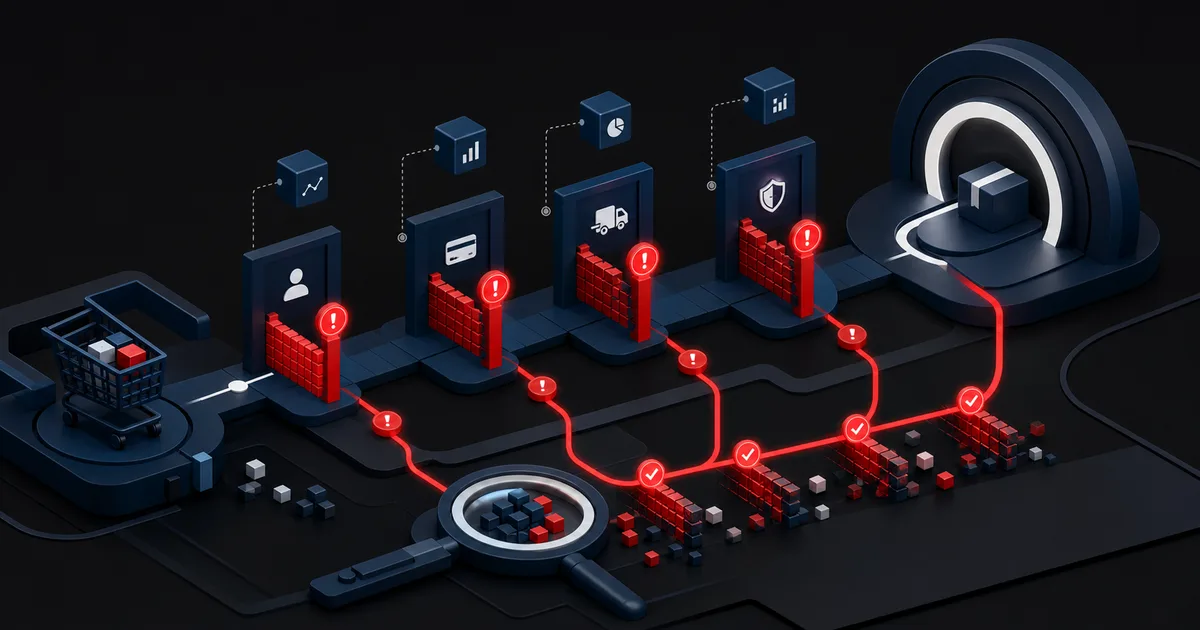
In most e-commerce teams returns are discussed as a single expense line: lower the rate, cut the cost. Yet the return policy is a promise the customer reads before buying and decides on. What happens after the sale determines whether a second order ever arrives.
Cart abandonment shows how early that promise takes effect. Baymard Institute's list compiling different studies reports a documented average cart abandonment rate of roughly seventy percent, and the visibility of shipping and extra costs is among the frequently cited reasons. Delivery and return terms therefore touch the sale long before the payment step.Baymard Institute — Cart Abandonment Rate Statistics (opens in a new tab)
1. The Return Policy Is a Marketing Decision
A customer takes a risk in a channel where they cannot see the product. The return policy says who carries that risk. When the terms are unclear, the customer carries it, and often simply does not buy.
Return terms are therefore not a document to be filed on a legal page but information to be read on the product page. How many days, in which cases, who pays and when the money comes back should be visible in three lines.
Widening the policy is not always the right answer. Free, long-window returns lift sales noticeably in some categories and merely generate try-it-out orders in others.
The right decision depends on the category, the average basket value and whether the product can be resold. Applying one policy across the whole catalogue is usually the most expensive option.
Clarify the legal ground while setting the policy; extended commercial promises sit on top of the statutory minimum rights rather than replacing them.
2. Tune the Policy by Category
A single return policy is rarely right. Whether the product can be resold after return, the ratio of shipping cost to basket value, and uncertainty about size or fit all call for different decisions.
The table below compares those variables. The aim is not to hand you a ready policy but to show which data the decision should rest on.
While filling it in, write down the resale value of a returned item as well. For a product that cannot be resold, a generous policy means a direct loss.
| Category trait | Source of uncertainty | Suitable approach | Indicator to watch |
|---|---|---|---|
| Size-dependent product | Fit uncertainty | Prioritise easy exchange | Exchange rate |
| High basket value | Price risk | Free return shipping | Conversion and return rate |
| Hygiene or personalised | Cannot be resold | Lawful exemption | Disputes and complaints |
| Low-value fast-moving goods | Shipping cost dominates | Keep-it resolution or no returns | Cost per unit |
| Technical product | Usage error | Setup support and guides | Support requests |
3. Set Delivery Expectations With Dates, Not Adjectives
Most dissatisfaction with shipping comes from uncertainty rather than delay. The phrase fast dispatch sets no expectation; an estimated delivery date does.
Show the date on the product page, repeat it in the cart and confirm it in the order email. The same information appearing consistently in three places removes a large share of support requests up front.
Do not save the shipping fee for the last step either. Extra costs surfacing at payment are among the most discussed reasons for abandonment and damage trust directly.
Staying silent about a delay is the most expensive option. Customers forgive the delay; they do not forgive not being told.
For cross-border orders, spell out customs, tax and timing uncertainty separately. When those items stay hidden, the return request ends up being about the process rather than the product.
- Show the estimated delivery date on the product page.
- Make the shipping fee visible early.
- Collect tracking in a single link.
- Report delays before the customer asks.
- Place the return action inside order details.
4. Hypothetical Scenario: Two Outcomes of Free Returns
A hypothetical clothing store shifts return shipping costs onto the customer to reduce its return rate. The rate does fall, but over the same period new-customer conversion and repeat orders decline as well.
The review shows most returns come from size mismatch. The problem is not opportunistic returning but missing sizing information before purchase.
The team removes the return fee again, adds a real measurement table and a fit note compiled from previous customer feedback, and separates the exchange flow from the return flow. This is a hypothetical example, not a client result or a guaranteed gain.
5. Separate the Operation From the Legal Ground
The return experience has two layers: the flow the customer sees and the operation behind it. If the visible side is fast but items sit unsorted in the warehouse for weeks, the refund is late and the trust you earned is lost.
Make the flow startable from the customer's account. Returns handled through email threads are slow and leave no record.
The legal ground sits underneath that design. Turkey's Distance Contracts Regulation grants consumers the right to withdraw from a distance contract within fourteen days without giving a reason and without paying a penalty, and obliges the seller to inform them of that right; the regulation also sets out the exceptions where it does not apply. Extended commercial terms you offer are added on top of that minimum.Turkish Distance Contracts Regulation — Legislation Information System (opens in a new tab)
For that reason, do not publish policy text written in marketing language without legal review. A wrong sentence about category exceptions, timing or refund method creates a commitment that is expensive to unwind later.
Collect return reasons in structured form too. A limited list of reasons rather than free text makes it measurable within three months why a particular product comes back.
Make the refund window visible
For a customer, a return ends when the money lands, not when the parcel ships. Publishing that window as an estimate beats leaving it unstated.
Send a notification at each step: request received, item arrived, inspection complete, payment initiated. Those four messages measurably reduce support load.
Separate exchange from return
When a size or colour exchange is handled in the same flow as a refund, customers may take their money back and buy elsewhere. A separate, faster exchange flow protects that sale.
Check stock at the start of an exchange. Cancelling an approved exchange because the item is out of stock costs more trust than the return itself.
6. A Four-Week Setup Sequence
Week one is measurement: instead of the return rate, look at return reasons, the split by category, the refund window and the number of return-driven support requests.
Week two is policy: set category-level terms, simplify the text and put it through legal review.
Week three is visibility: make the delivery date, shipping fee and return terms consistent across product page, cart and post-order communication.
Week four is operation: move return initiation into the account, set up the notifications and measure inspection time on the warehouse side.
At the end of week four, read the policy once more with the support team. They know which sentence customers ask about most; every unclear line becomes a repeated support request later.
- Return reasons structured.
- Category-level policy written.
- Text reviewed by legal.
- Delivery date consistent in three places.
- Shipping fee visible early.
- Returns can be started from the account.
- Refund window measured.
7. Limits and Failure Modes
A good return experience cannot rescue a bad product. Repeated returns on the same item point to the description, the quality or the supplier rather than the policy.
A generous policy is also open to abuse. Rather than turning edge cases into rules, handling a small number of accounts separately manages the risk without punishing the majority.
Driving the return rate to zero is not the goal. A certain level of returns is the natural consequence of selling to a broad audience; a near-zero rate usually means you are selling to a narrow one.
The legal framing here is general information and does not replace legal advice. For category exceptions and obligations, consult the current regulation text and a qualified adviser.
Finally, the effect of a policy change is not readable immediately. Because the return cycle takes weeks, compare only after at least two full cycles.
Conclusion
The returns and delivery experience begins before the sale, not after it. Tune terms by category, show dates and fees early, make the operation visible and measure why products come back.
Frequently Asked Questions
Sources
- Baymard Institute — Cart Abandonment Rate Statistics (opens in a new tab)
Compilation of documented average abandonment rates
- Turkish Distance Contracts Regulation — Legislation Information System (opens in a new tab)
Fourteen-day right of withdrawal and its exceptions
Let us make returns and delivery part of the sale
We set your policy at category level and design visibility and operations together.
Request an e-commerce experience audit