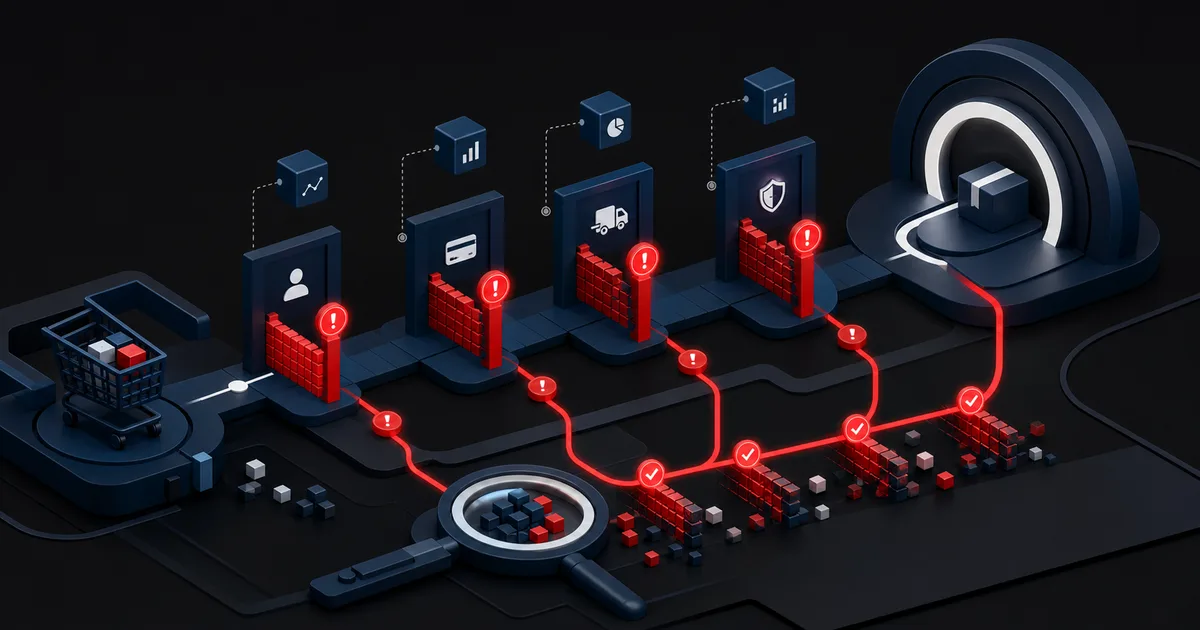
The first order is worth celebrating, but for a sustainable e-commerce business the real questions start right after it. Will the product arrive on time, will the customer actually start using it, can they reach the brand when they need help, and will they think of you when the next need comes up? Retention is not a matter of calling people back with a constant stream of messages. It is the operating system that keeps the original promise all the way from delivery through daily use. That makes it a shared responsibility of product, logistics, support, and data teams, not marketing alone.
Google Analytics ships a retention report that shows new and returning users, cohorts grouped by acquisition day, and how users come back across their first 42 days. The user lifetime exploration adds a second angle by letting you judge an acquisition source against lifetime revenue and engagement. Both are a starting point rather than an answer. Neither one explains customer value until you join it with your own order, return, margin, and consent data.Google Analytics Help — Retention overview report (opens in a new tab)Google Analytics Help — User lifetime (opens in a new tab)
1. Define the retention problem before you chase repeat orders
Repeat order rate is a useful outcome metric, but it never tells you why. If a product is naturally bought once a year, a low repeat rate may not be a problem at all. For a consumable, silence after the first order can point to delivery, quality, usability, or reminder failures. Start by writing down the product's expected replenishment cycle, the moment the customer actually uses it, and the trigger that makes them reconsider. Anchor your measurement to that behavior model, not to an industry average.
Separate retention from loyalty as well. A customer who orders a second time because of a discount has returned in economic terms, but you cannot conclude yet that they prefer the brand. Full-price repeat orders, satisfaction after a support case, movement into complementary products, and engagement on consented channels give you a wider picture. Lifting order count on its own creates no value if returns and incentive costs grow alongside it.
Your opening definition should answer three questions. Which customer behavior do we want to protect, over what time window, and against which business outcome? That keeps teams from using the same word for different goals.
2. Read lifetime value as contribution, not revenue
There is no single universal formula for customer lifetime value. A simple starting model multiplies orders per customer by average contribution per order. A more mature model accounts for gross profit over time, returns, discount costs, service expense, and the time value of money. Whichever model you use, keep the calculation window and the assumptions visible on the dashboard. Never present forecast revenue as if it were realized profit.
Bring acquisition cost down from the channel total to the customer cohort as well. Two channels that deliver the same first-order revenue can produce very different value once returns, repeat purchases, and support load are counted. A loss on the first order can be a deliberate investment, but when the payback period runs past what cash flow allows, the business struggles while growth still looks healthy. The retention budget therefore cannot be planned independently of the media budget. Plan both against unit economics.
When you build value segments, do not reduce people to scores waiting to be manipulated. Let a segment serve one purpose, which is choosing the experience that is genuinely useful: a setup guide for a new customer, easy replenishment for a regular user, a preference center for someone you have not seen in a long time.
| Metric | What it tells you | Risk on its own | Balancing check |
|---|---|---|---|
| Repeat order rate | Buying again inside a set window | Blind to the product cycle | Category and first-product cohort |
| Order frequency | The rhythm between orders | Can be inflated by discounts | Full-price share and margin |
| Lifetime revenue | Turnover accumulated per customer | Hides return and service cost | Contribution profit |
| Payback period | How fast acquisition spend returns | Sensitive to future assumptions | Cash flow scenario |
| Consented reach | Customer base you can contact | Says nothing about message quality | Complaints and unsubscribes |
3. Build the post-purchase journey around moments of use
Operations fills the gap between the order confirmation and the next campaign. The confirmation message sets the expectation. A shipping update reduces uncertainty. Post-delivery content helps the customer set the product up or use it correctly. A support touch shows whether the problem was actually solved. Every touch has a different job. Pushing the same sales message into all of them ignores the task the customer is trying to complete at that moment.
Tie the journey to verifiable events rather than calendar days. Sending usage tips for an order that has not shipped, or cross-selling to a customer with an open return request, damages trust. Useful events include order confirmation, delivery, a first-use signal, a closed support case, and the estimated replenishment date. For every trigger, define the source system, the delay tolerance, and the failure behavior.
Cap communication frequency and give the customer control over channel and topic. Do not treat an operational notification as marketing consent. Consent, retention, and deletion requirements have to be verified with your legal and privacy teams for each country you operate in.
- Take order and delivery status from one reliable source.
- Prepare product-specific help for first-use obstacles.
- Check support and return signals before any sales message goes out.
- Set replenishment reminders to the real consumption interval.
- Manage channel, topic, and frequency preferences in one place.
4. Hypothetical scenario: repeat coffee purchases without a subscription
This scenario is hypothetical. It is not a customer result or a performance promise. Picture a shop that sells roasted coffee in three bag sizes. The first order tells you the bag size and the grind preference, but not how many people at home are drinking it. Instead of sending everyone a coupon on day fourteen, the team estimates a likely consumption range from bag size and works with a wide window.
No sales message goes out in the first week. The customer gets a storage and brewing guide instead. If there is a delivery problem or a low rating, the replenishment flow stops and support takes priority. Around the estimated end of the bag, the customer can reorder in one tap, change the quantity, or push the reminder back. A discount is tested only in a sub-cohort where price sensitivity is being measured, and always against a control group.
The decision is not to force every customer into a subscription. A customer with a steady rhythm who wants convenience gets the subscription option. A customer with variable consumption gets flexible reordering. Someone buying a gift gets a separate path that does not badger them with replenishment prompts. Success is judged on contribution profit, returns, support requests, and cancellations alongside repeat orders.
5. Separate causes with cohorts, decide with experiments
A monthly chart of total repeat sales mixes customer quality with calendar effects. Build cohorts on attributes that carry meaning: first-order month, acquisition channel, first product, discount use, and delivery experience. Do not slice very small groups any further, or you will mistake random variation for insight. Using the same observation window for every cohort keeps the comparison fair.
Write down the primary outcome before the experiment runs. A reminder that lifts repeat orders while cutting margin or raising complaints has not won. Account for the control group, the cost of the offer, delayed conversions, and spillover between channels. A customer may see the email and come to the site directly days later, so last click cannot decide on its own.
Shopify's official customer reports explain RFM analysis through recency, frequency, and monetary value, and a predicted spend layer derives customer potential tiers from past purchase behavior. Availability and plan requirements for these features can change, so treat a ready-made segment as a hypothesis rather than the truth and confirm it against your own margin and experience signals.Shopify Help Center — Customers reports (opens in a new tab)
6. An eight-week retention rollout plan
Spend the first two weeks mapping the data flow from order to return, the consent states, and every touchpoint. In weeks three and four, define the natural replenishment cycle of each product family along with your core cohorts. In weeks five and six, build exactly one journey, for example the post-delivery flow that gets people using the product. In the final two weeks, read the result with a control group and balancing metrics, and resist scaling a message that did not work.
Give every flow an owner, an entry condition, a stop condition, and a quality metric. Marketing owns the copy, operations the delivery signal, support the exceptions, and analytics the measurement. That is what keeps automation from being orphaned inside a tool account.
- We have written down the expected repeat-purchase window for each product.
- We track lifetime value as revenue and as contribution profit separately.
- Returns, support cases, and delivery problems stop the sales flow.
- Every message has a documented source event and delay tolerance.
- We measure incremental impact against a control group.
- Channel, topic, and frequency preferences sit with the customer.
- Every experiment has a complaint, unsubscribe, and margin threshold.
7. Limits and failure modes: not every return is a good one
Retention cannot fix a weak product. If delivery stays late, the return policy unclear, the quality poor, or support unreachable, more messages only make the problem more visible. Heavy discounting can train customers to wait for the next promotion. An aggressive subscription flow can make cancellation hard. Personalization that misses the mark can feel like an intrusion on privacy. When those symptoms appear, repair the core experience instead of speeding up the automation.
Measurement has limits too. Identities that do not merge across devices can show one person as several customers. Purchases made outside the store may stay invisible. For long product cycles, a short window misleads. Predicted LTV guarantees nothing about the future, and history is thin for new products. State the data coverage, the model date, and the known unknowns plainly on your dashboards.
The final decision is simple. The goal is not to bring customers back as often as possible, but to make it easy for them to choose you again when they genuinely need to. If the value proposition, operations, and consented communication do not strengthen each other, the retention program is not sustainable.
Conclusion
Healthy e-commerce retention comes from a promise that is kept, not from a coupon calendar. Define the natural buying rhythm, read lifetime value as contribution profit, tie journeys to real events, and run every experiment inside limits that protect customer trust. That is how a single sale turns into a long relationship through consistent value rather than relentless messaging.
Frequently Asked Questions
Sources
- Google Analytics Help — Retention overview report (opens in a new tab)
Cohorts, returning users, and the first 42 days of retention
- Google Analytics Help — User lifetime (opens in a new tab)
Lifetime user exploration covering revenue and engagement
- Shopify Help Center — Customers reports (opens in a new tab)
RFM customer analysis and predicted spend reports
Build repeat purchase on trust and unit economics
Let us design your post-purchase journey, your measurement model, and your first retention experiment together.
Build my retention roadmap