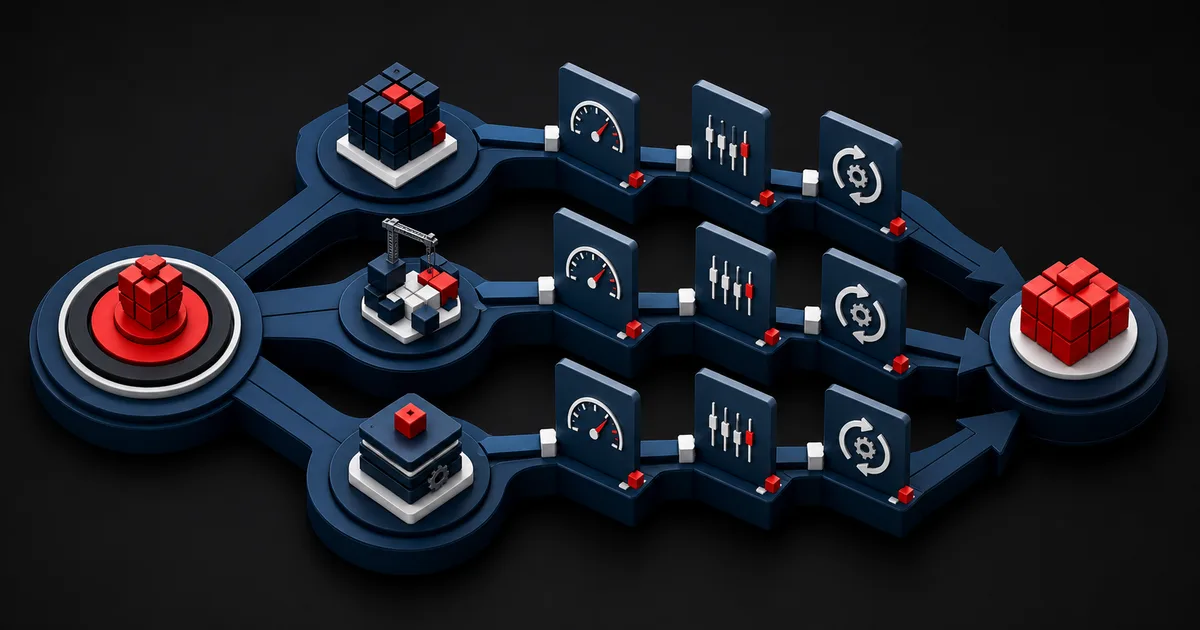
Most mobile technology meetings open with tool names: Swift or Kotlin, Flutter or React Native, or no-code? That order is backwards. Start by defining which device capabilities the product depends on, how it behaves offline, where its performance ceiling sits, how often you ship, how the team is structured, and how long the app is meant to live. Two apps with the same screen count can carry completely different technical risk once camera processing, background jobs, payments, accessibility or heavy animation enter the picture.
Build vs. buy is not a binary choice either. You can develop the core experience in your own code while buying capabilities such as identity, payments, notifications or content management as a service. You can validate an internal operations prototype with no-code and build the customer-facing app on a different stack. The goal is not to write as little code as possible. It is to control what makes you different, acquire the standard work reliably, and keep the future cost of change visible.
1. Map Product Risk Before Technology
Your first document should be a risk map, not a feature list. Does product success depend on live camera work, Bluetooth, location, health data, low-latency audio, complex graphics or background execution? Will the app live only on phones, or also on tablets, watches and desktops? Which modules are touched by security, regulatory, data residency and offline requirements? These questions reveal how much the technical decision actually weighs.
Next, map what will change. Screens you plan to experiment with frequently, the long-lived transaction core and third-party integrations do not evolve at the same pace. Keeping the volatile surface modular is worth more than locking the entire product into the limits of a single tool. Separate first-release scope from the three-year product vision: do not over-engineer today for remote possibilities, but do not defer known high risks until after the prototype either.
Write down the measure of success: store launch date, completion time for the critical task, crash-free sessions, accessibility, offline usability or release capacity per team. "Faster development" only means something when you can say what exactly gets faster.
2. Compare Native, Cross-Platform and No-Code on the Same Criteria
Native development works directly with the platform's official language and UI framework. It is a strong candidate when early access to the newest operating system capabilities, platform-specific behavior and fine-grained performance control matter. The price is separate expertise, code and test surface for iOS and Android coverage. Shared business logic or a common design system reduces duplication, but you still manage two platform lifecycles.
A cross-platform approach aims to reach several targets from one codebase. It can pay off when product flows are similar, platform customization is limited and you run a single team. Shared code does not mean zero platform work, though. Native modules, store policies, device behavior, accessibility and version upgrades still demand separate verification. When you evaluate a framework, look past today's component catalog and examine who maintains it.
No-code and low-code tools can shorten delivery for prototypes, internal apps, form-heavy processes and standard data flows. Where you need complex offline synchronization, custom device integrations, rich interaction or portability, test the limits early. Ownership of the generated code, export options, pricing, plugin quality and platform shutdown terms all belong in the contract in writing.
| Criterion | Native | Cross-platform | No-code / low-code |
|---|---|---|---|
| Platform depth | Highest direct access | May need a plugin or bridge | May be capped by the tool catalog |
| Shared development | Limited | Can be high | High for standard flows |
| Custom interaction | Fine-grained control | Framework plus native work | Risk of template limits |
| Team requirement | Platform specialists | Shared stack plus platform knowledge | Tool expertise and governance |
| Exit risk | You own the code, tied to the platform | Framework and plugin dependency | Vendor and data portability are critical |
3. Read the Official Support Matrix and the Architecture Together
Flutter's official support matrix publishes, release by release, which operating system and hardware combinations are supported, which are tested in continuous integration and which are not supported at all. Because that list changes over time, match your target devices against the current official matrix rather than the "runs everywhere" line in a sales deck. A supported target does not mean every plugin and behavior in your product is equally mature.Flutter Documentation — Supported deployment platforms (opens in a new tab)
Android's official architecture guide recommends separating user interface responsibilities from the data layer and follows a single source of truth and a data-driven UI, while stating plainly that the advice has to be adapted to context. Those principles are not only useful for native Android. They make a good test when you assess candidate technologies: how much business logic gets embedded in the tool, where does data access live, and can modules be tested on their own?Android Developers — Guide to app architecture (opens in a new tab)
Create a trial repository and build the riskiest vertical slice end to end. Identity, a real API, local storage, notifications, accessibility and the delivery pipeline all belong in that slice. A prototype of static screens alone will not expose integration and lifecycle risk.
4. Hypothetical Scenario: A Hybrid Decision for a Field Service App
This scenario is hypothetical; it is not a client case or a guarantee of timelines. Picture a maintenance company planning an app for its technicians. The core tasks are viewing work orders, attaching photos, collecting signatures and filling in forms with no connection. In the first year only company-issued phones are in scope, with a customer portal and tablet support expected later. The team is strong in web technologies but has limited experience with mobile offline synchronization.
The no-code candidate builds the form and admin screens quickly, but hits limits on large photo queues, conflict resolution and device policy testing. The native candidate offers the most control, yet there is no team for two platforms. With the cross-platform candidate, a small vertical slice is built covering offline data, camera and background upload, and the critical synchronization layer is designed as a module kept independent of the framework.
The decision is not to build the whole system in one tool. The technician app goes cross-platform while the admin panel stays on the web, and identity and file transfer are bought as managed services. If device management is ever locked to Android only, native Android is recorded as a threshold for reassessment. This approach uses the team you have today without pretending that a future change of direction is free.
5. Calculate Total Cost of Ownership Across the Lifecycle
The quote for the first release is not the total cost. Design adaptation, automated tests, a device lab, store accounts, observability, security updates, SDK upgrades, accessibility fixes and operating system migrations all enter the budget. For services you buy, look at how the price moves as usage grows; for your own code, price in the cost of losing specialists and running a maintenance rotation.
Model the cost of switching from the start as well. Can you export data in a standard format, are business rules embedded in the vendor's proprietary flow language, will your tests validate a new implementation, and can user sessions and subscriptions be migrated? An exit plan is not about rewriting everything easily; it is about choosing irreversible dependencies deliberately.
Do not overlook team economics. A technology that is popular on the market is not automatically cheap for your team. Time to hire, the balance of seniority, the learning curve and code review capacity are all part of delivery risk.
- Model three years of license, infrastructure and third-party fees.
- Budget capacity for operating system and framework upgrades.
- Add test devices, observability and support load.
- Verify data and business rule portability in the contract.
- Establish ownership of critical knowledge in at least two team members.
6. A Six-Week Technology Decision Plan
In week one, identify user tasks and the capabilities that cannot fail. In week two, write down platform, security, data, accessibility and distribution constraints. In weeks three and four, build the same risky vertical slice with no more than two strong candidates. In week five, compare results for performance, devices, offline behavior, testing and distribution. In week six, prepare a decision record covering total cost, team and exit conditions.
The decision record should capture not only the winner but also the rejected options and the assumptions behind them. Define the triggers for reassessment: a new platform, a heavy device integration, a licensing change, a performance threshold or a shift in team structure. That turns the technology choice into an evidence-based, traceable product decision rather than a vow of eternal loyalty.
- We wrote down the critical user tasks and quality thresholds.
- We verified the target device and operating system matrix.
- We tried the riskiest vertical slice with real integrations.
- We estimated how much platform-specific work is involved.
- We modeled three years of maintenance and license cost.
- We prepared an exit plan for data, code and business rules.
- We defined the triggers that would reopen the decision.
7. Limits and Failure Modes: A Tool Is No Substitute for Product Strategy
The most common mistake is turning the share of shared code into a success metric. Even when most of the code is shared, the critical percentage can still require expertise on both platforms. Conversely, separate native apps without proper modularity produce the same mistake twice. A no-code solution can start fast and turn into a tangled chain of plugins as custom requirements pile up. Every approach is expensive when it is applied badly.
A benchmark result is not the whole user experience either. Animation that runs smoothly on a lab device can break down on an older phone, under accessibility settings, on a weak network or with background restrictions. Store policies and platform APIs change. Archive the official support page as of your decision date, assign an owner for upgrades, and rerun the critical flow on real devices.
The final limit is organizational. Technology with no owner ages even under the best architecture. The choice should be the solution your team can develop, test, observe and update with confidence. Buying the modules that do not carry your product differentiation, while deliberately controlling the core capability, is usually the more balanced build vs. buy approach.
Conclusion
Take mobile technology selection out of the popularity contest and base it on product risk, team capacity and lifecycle cost. Run the same critical flow through native, cross-platform and no-code candidates, and record official support, platform-specific work, exit conditions and maintenance ownership. The right stack is not the one promising the most features; it is the one that keeps your product's distinguishing job running reliably.
Frequently Asked Questions
Sources
- Flutter Documentation — Supported deployment platforms (opens in a new tab)
Release-by-release matrix of supported and tested target platforms
- Android Developers — Guide to app architecture (opens in a new tab)
Layers, single source of truth and testable mobile architecture principles
Validate your technology choice against real product risk
Let's build an actionable mobile technical roadmap covering your critical user flow, the candidate stacks and lifecycle cost.
Review my mobile approach