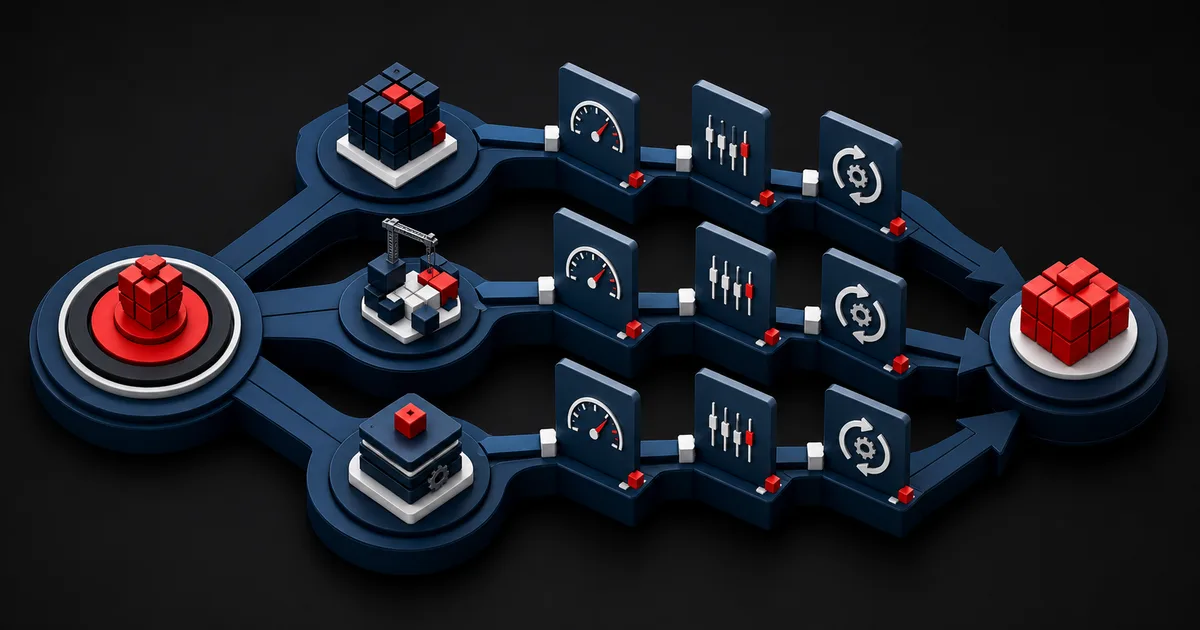
An MVP is not a smaller copy of the final product. It is the smallest responsible release that lets a defined audience reach a valuable outcome and lets the team learn whether the riskiest assumptions are true. Cutting visible features while ignoring privacy, reliability, support, analytics, and store requirements creates a demo—not a viable product.
Apple's review rules and Android's quality and release guidance make baseline responsibilities visible, while Apple's onboarding guidance encourages teams to move people toward value without unnecessary instruction. Store approval is not the product strategy, but release requirements must enter scope early.Apple Developer — App Review Guidelines (opens in a new tab)Android Developers — Core app quality guidelines (opens in a new tab)Android Developers — Prepare your app for release (opens in a new tab)Apple Human Interface Guidelines — Onboarding (opens in a new tab)
1. Write a Learning Contract Before a Feature List
Name the audience, recurring problem, first valuable outcome, riskiest assumption, evidence you need, and decision that evidence will unlock. 'Users want the app' is too broad; specify who, in which situation, and what behavior would demonstrate value.
Set ethical and commercial boundaries. Some assumptions can be tested with a prototype or concierge process before software. Others require a reliable release because trust, notifications, payments, or stored data are central.
Rank assumptions by uncertainty and consequence. Desirability, usability, technical feasibility, distribution, operations, and economics may not carry equal risk. Test the assumption that could invalidate the investment first, and avoid using easy engagement data to answer a harder question about willingness, reliability, or sustainable delivery.
2. Use Must–Should–Defer with Risk
A must is required for the core outcome, legal or store compliance, safety, data integrity, or measurement of the main assumption. A should improves the result but can wait briefly. Defer items are explicit non-goals with a trigger for reconsideration.
Estimate dependency and operating cost, not only development effort. A seemingly small feature may introduce moderation, billing, notification, support, or sensitive-data obligations.
Make trade-offs explicit in outcome language. If social login is deferred, state the effect on time to value and account recovery; if chat is included, accept moderation and response obligations. Review the matrix when research changes the riskiest assumption, not whenever a stakeholder proposes a desirable feature.
| Class | Question | Evidence |
|---|---|---|
| Must | Can the outcome or responsible release exist without it? | Requirement or critical dependency |
| Should | Does it materially reduce friction? | Observed need |
| Defer | Can learning proceed safely without it? | Review trigger and date |
3. Include the Invisible Product Work
Scope authentication, permissions, data deletion, error handling, offline or poor-network behavior, logging, analytics, accessibility, localization foundations, security updates, support tools, and incident ownership. They may not appear in a pitch deck, but users experience their absence.
Choose architecture for the validated horizon. Avoid both a throwaway prototype presented as production and speculative infrastructure for millions of users. Document what can scale later and what would require redesign.
Run technical discovery before committing to a delivery estimate. Validate platform APIs, third-party SDK behavior, sensitive-data flows, device support, background work, store-account access, and integration ownership with small proofs where uncertainty is high. Discovery should reduce a named risk and end with a scope decision, not become open-ended architecture work.
4. Create Gates for a Releasable Product
Define acceptance for the core journey, crashes, data loss, privacy disclosures, accessibility, performance on representative devices, store assets, support, monitoring, and rollback. Assign an owner to every gate.
Run internal, closed, or staged testing where appropriate. Approval by a store does not prove usability, and a successful demo does not prove resilience.
Set thresholds and escalation rules before launch pressure rises. Decide which defects block release, which can enter a time-bound remediation plan, who can approve an exception, and how a staged rollout will stop. Test fresh installs, upgrades, denied permissions, interrupted networks, expired sessions, and recovery—not only the ideal first run.
| Gate | Pass condition |
|---|---|
| Core outcome | Completes across expected states |
| Data | Consent, retention, deletion, and recovery verified |
| Quality | Critical crashes and blockers resolved |
| Operations | Monitoring, support, and rollback ready |
| Distribution | Store, signing, rollout, and rollback access confirmed |
5. Hypothetical Scenario: Scoping an Appointment App
This example is fictional. A team proposes provider discovery, booking, payment, chat, loyalty, referrals, and social profiles for version one. Research shows the riskiest assumption is whether a small target group will complete and attend a confirmed appointment.
The MVP keeps verified availability, booking, confirmation, cancellation rules, reminders, support, and outcome measurement. It defers chat, loyalty, and social features with explicit review triggers. The scope becomes smaller but more complete around the chosen result.
6. Shorten the First Session from Explanation to Value
Ask only for information needed to deliver the first outcome or meet a clear requirement. Explain permissions in context, allow safe postponement, preserve progress, and use examples or defaults instead of a long tour.
Measure the path from open to outcome: eligibility, account step, permission choice, task start, completion, error, and time to value. Pair events with interviews and support evidence so a completion rate is not mistaken for understanding.
7. Common Mistakes, Limits, and the Working Checklist
Avoid calling an unreliable prototype an MVP, making every stakeholder request mandatory, postponing privacy and accessibility, tracking only downloads, and building speculative scale before demand. Do not use urgency to remove responsible release work.
An MVP cannot answer every market question. State the audience and learning boundary, then plan what evidence would justify expansion, change, or stopping.
Some domains set a higher minimum. Products handling health, finance, children, identity, physical safety, or consequential automated decisions may need specialist review, stronger assurance, and broader failure testing before any public learning is responsible. 'Minimum' never overrides duty of care or current legal and platform obligations.
- Audience, outcome, assumption, and decision are explicit.
- Must items include compliance and operational readiness.
- Deferred features have triggers, not vague promises.
- Core journeys include failure and recovery states.
- Store, privacy, accessibility, analytics, and support gates have owners.
- Learning combines behavior with qualitative evidence.
- High-risk domain limits and specialist approvals are documented.
- A documented stop decision prevents scaling on ambiguous evidence.
Conclusion
Good MVP scope is disciplined completeness around one outcome. Protect responsible release work, defer unrelated ambition, and make every included feature earn its place through the learning contract.
Frequently Asked Questions
Sources
- Apple Developer — App Review Guidelines (opens in a new tab)
Official App Store review requirements
- Android Developers — Core app quality guidelines (opens in a new tab)
Official baseline Android quality guidance
- Android Developers — Prepare your app for release (opens in a new tab)
Official release preparation guidance
- Apple Human Interface Guidelines — Onboarding (opens in a new tab)
Official onboarding design guidance
Turn version-one negotiation into a learning plan
Define the core outcome, scope matrix, and release gates for a dependable mobile MVP roadmap.
Plan my mobile MVP