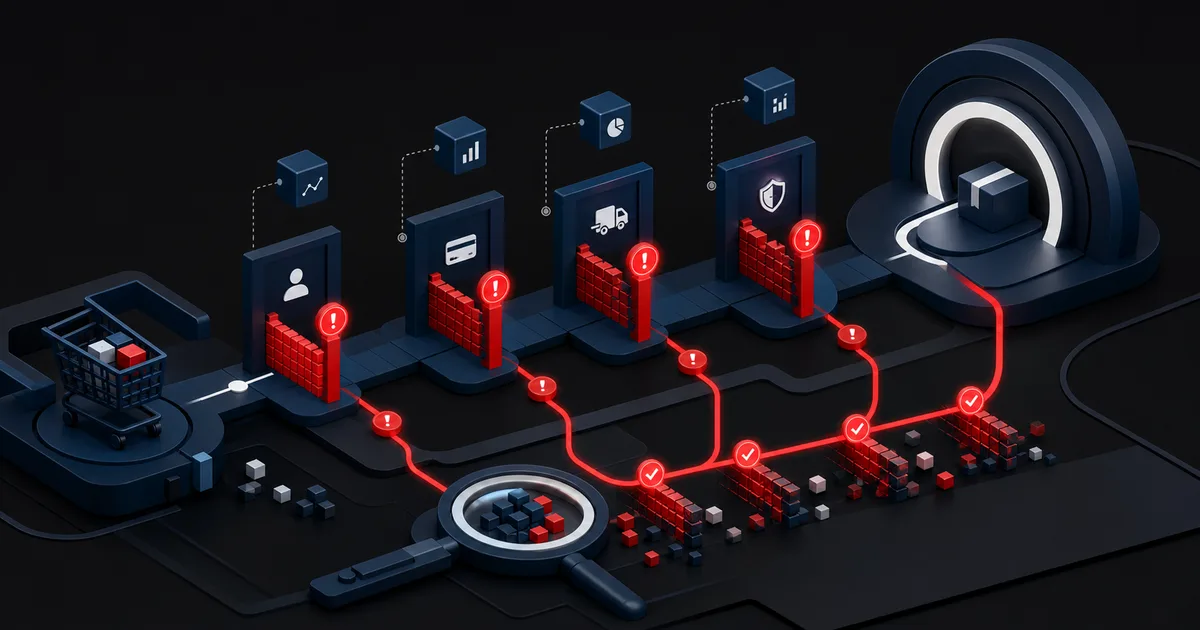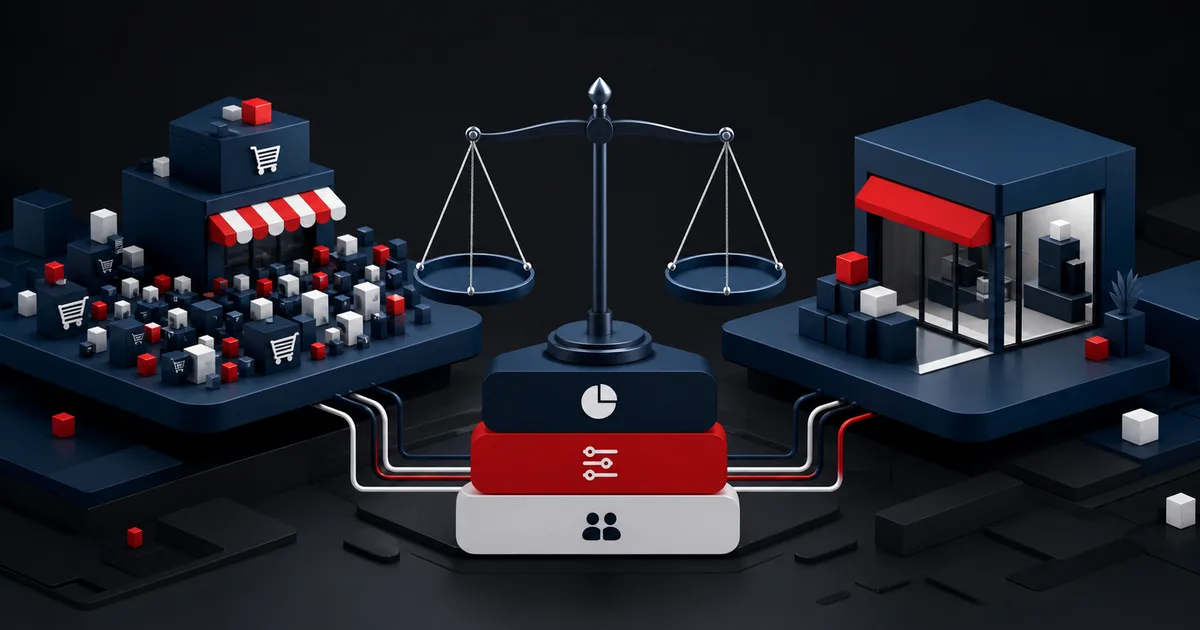
The marketplace-versus-own-store question is usually argued between two wrong extremes. One side treats a marketplace as ready-made traffic and effortless sales. The other imagines an owned store as a commission-free space with total freedom. In reality, visibility on a marketplace is earned through advertising, service levels and platform rules. On your own store, you carry the cost of traffic, trust, payments, support and technology yourself. The right call comes from per-order economics and the level of strategic control you need, not from the label on the channel.
The OECD's work on the digital transformation of small and mid-sized businesses points out that a company can sell through its own site or app, through an online marketplace, or through both at once; the options are not mutually exclusive. That framing is a useful reminder: the decision is rarely "which one?" but rather which customer, product and job each channel is meant to serve. Instead of copying old market averages as if they were current performance targets, produce your own data.OECD — The Digital Transformation of SMEs: Online Platform Economy (opens in a new tab)
1. Start the Channel Decision With the Product and Customer Behavior
A product with a standard name and a comparable price can find demand quickly on a marketplace, where shoppers search across many sellers. A product that needs explanation, advice, personalization or a strong brand story is usually told better on your own store. That is a hypothesis to test, not a rule. Search behavior, decision time, basket structure, return reasons and support needs determine which channel fits.
Examine where the customer's trust comes from. For a new brand, a marketplace's payment, delivery and review infrastructure can take the uncertainty out of a first transaction. When repeat purchases, membership, product education or in-depth content matter, your own experience gives you far more room. Do not read a high marketplace rating as brand loyalty; the customer may simply have chosen the platform.
Do not force the whole portfolio under one decision. Entry-level products can drive discovery on a marketplace while custom bundles, spare parts or subscriptions make more sense on your own store. Define the channel's role at the level of the product family and the customer stage.
2. Calculate the Order Economics Beneath the Visible Commission
Marketplace cost is more than commission. Listing or service fees, on-platform advertising, storage, shipping, returns, penalties, campaign contributions and payout terms all change what actually lands in cash. An owned store has its own list: payment provider, platform, development, hosting, security, content, acquisition media and operational time. Comparing only the per-order fee while ignoring fixed cost manufactures a false winner.
Build a contribution table for each channel. Start from net sales and subtract cost of goods, channel variable expenses, shipping, a returns provision, promotions and the customer service load. Then show fixed technology and team cost separately. That way you can see which line moves as volume grows and which one spreads out with scale. Confirm tax and accounting treatment with a qualified specialist.
Average order value alone is not enough. Cohort fragile, bulky or return-prone products separately. If payout terms are long, a channel that looks profitable can still strain working capital.
| Dimension | Signal favoring the marketplace | Signal favoring your own store | Evidence to measure |
|---|---|---|---|
| Demand | Existing category search on the platform | Branded, content-supported demand | Searches, clicks, new customers |
| Economics | Low upfront fixed cost | Controllable cost at sufficient volume | Contribution profit and payback |
| Experience | Standard products and fast comparison | Education, bundles, membership, personalization | Conversion, support, returns |
| Data | Platform reporting is sufficient | First-party relationship is critical | Accessible fields and consent |
| Risk | Validating a new channel | Reducing platform dependency | Revenue concentration and outages |
3. Assess Control, Data and Brand Space Realistically
Your own store gives you more control over page layout, content, bundling, cross-sell and service flows. But control is not an unlimited right to collect data. Gather only what a defined purpose requires, and manage consent and retention rules. The customer and performance fields you can reach on a marketplace vary by contract, role and country; do not assume the fields an integration exposes today will be there permanently.
Brand experience is not limited to the color of the box either. Product accuracy, stock consistency, delivery, response time and returns handling shape brand perception on every channel. If your own store builds a strong narrative but stumbles on logistics, the control advantage produces nothing. On a marketplace, discipline in product titles, imagery, variants and buyer questions can set you apart even inside a standard template.
The EU's official summary of the regulation on platform-to-business relations covers topics such as making terms and conditions intelligible, disclosing the main parameters that determine ranking, and defining the business user's technical and contractual access to data. Because the status and scope of such rules can change over time, treat this example as a checkpoint rather than legal advice: review platform terms, ranking and data access as separate lines in your channel risk table.EUR-Lex — Online intermediation services: fairness and transparency for business users (opens in a new tab)
4. Hypothetical Scenario: A Home Organization Brand Decides on a Hybrid Model
This example is hypothetical and does not describe a real client outcome. Picture a small brand selling storage boxes, with twelve standard products and made-to-order bundles. On the marketplace, the standard items get searched for and the first sales arrive faster, but contribution after advertising and returns varies from product to product. Its own site sees few visits, yet the people who read the bundle guide build noticeably larger baskets.
The team does not push the entire catalog everywhere. It keeps the four most-searched standard products on the marketplace and improves the product pages and stock synchronization. On its own store it offers a bundle builder based on room dimensions, usage content and spare parts. Rather than matching channel prices blindly, it makes the differences in service, bundling and cost transparent, and reviews the terms in force separately.
Over eight weeks the team tracks new customer contribution, return reasons, support minutes, payout timing and which channel receives the second order. The decision is neither to shut down the marketplace nor to make the site the only measure of success; it is to position the marketplace for discovery of standard products and the store as the home of guided bundles and customer relationships. Nothing about the outcome is guaranteed, and the model is reweighed as data arrives.
5. Build One Source of Truth and Clear Channel Roles in a Hybrid Model
Two channels must not turn into two separate companies. Designate a primary source for product codes, stock, cost, order status and return reasons. Write down how overselling is blocked when a platform integration lags, in what order price changes are published, and how cancellation data reaches accounting. Make the owner of every manual step and its upper volume limit visible.
Channel conflict is not only a pricing problem. A different description, a different warranty promise or an outdated image for the same product confuses the customer. Establish a shared product information model; shorten it per channel, but never change the core claims. Support staff should be able to see which channel an order came from and which process applies.
Do not move an order taken on a marketplace into a marketing list without permission. On your own store, do not chase data with forced account creation or dark patterns either. A first-party relationship is earned through a trustworthy exchange of value.
- Use a single SKU dictionary for every product and variant.
- Name the source system for stock, price and order status.
- Document the service level and returns flow for each channel.
- Define a management threshold for revenue concentration.
- Prepare a communication plan for platform outages and account restrictions.
6. Run the Ninety-Day Channel Pilot in Stages
In the first month, build the product-level contribution model, examine your existing demand sources, and document the current contract, fee, data and operating terms of the marketplace you have chosen, straight from the source. In the second month, start the pilot with a limited product group and limited stock while you finish the measurement, content and checkout foundation on the store side. In the third month, compare each channel using the same order definition and the same cost scope.
Write the pilot's exit rules before you start. Set thresholds for the margin floor, acceptable returns, support capacity, stock accuracy and payout timing. A single campaign week or seasonal peak is not enough to make a permanent decision. Keep the learning period and the scaling period distinct.
- We grouped products by channel fit.
- We accounted for every variable cost beyond commission.
- We showed fixed technology and team cost separately.
- We recorded the contract, ranking and data access terms.
- We designated a single source of truth for stock and orders.
- The pilot's success and stop thresholds are written down.
- Channel results are read alongside new customers, contribution, returns and cash.
7. Limits and Failure Modes: Make Dependency Visible
The core marketplace risk is concentration. When most revenue comes from a single platform, a change in fees, ranking, policy, operations or account status can hit the business fast. The core risk of an owned store is underestimating demand generation and technical responsibility. Launching a site does not create visitor trust or profitable acquisition. On either channel, fake reviews, inaccurate product claims and thin support destroy value over time.
A hybrid model is no automatic safeguard. When integration breaks, stock errors and cancellations climb; when the team is small, running two content and campaign calendars splits quality in half. Match the number of channels to your capacity. If one channel does not support the other and carries no distinct customer role, it may not be worth the complexity.
The best decision is not picking whichever channel produces the highest revenue today. A good decision is the mix that delivers the right experience to the customer while keeping contribution, cash, data responsibility and channel dependency within acceptable limits. When those limits shift, the portfolio decision should shift with them.
Conclusion
A marketplace can offer fast discovery and established transaction trust; your own store can give you far more control over experience, relationships and how the product is explained. Compare them through product roles, order contribution, data access and operational capacity rather than slogans. A limited pilot with clear thresholds turns the channel question from an assumption into a measurable portfolio decision.
Frequently Asked Questions
Sources
- OECD — The Digital Transformation of SMEs: Online Platform Economy (opens in a new tab)
How smaller businesses can sell through their own site, a marketplace, or both together
- EUR-Lex — Online intermediation services: fairness and transparency for business users (opens in a new tab)
Official regulatory summary covering platform terms, ranking and business access to data
Design your sales channels around durable economics, not top-line revenue
Let us model product-level channel roles, unit economics and hybrid operating requirements together.
Review my channel model